SYMBOLS & STORIES · TatTryOn editorial
Lotus Flower Tattoo Meaning
Lotus flower tattoo meaning: choose the story first
Help me make this meaning personal →
Purity, rebirth, and spiritual awakening
Start by deciding what growth means in your own life. It could be learning to live differently, finishing a demanding chapter, or keeping a daily practice. A lotus gives that idea a recognizable shape without requiring a date or a sentence. You do not have to describe a painful experience publicly to explain why you chose a flower. A simple answer such as “it reminds me to keep growing” can be enough.
The design can support your story without pretending to be a secret code. An opening flower might be your way of describing progress still in motion; a fully open bloom might mark a moment of arrival. Those are optional design interpretations, not rules that every wearer shares. Write the intended meaning down before choosing decorative additions, so the finished reference has a clear focus.
Hindu and Buddhist interpretations
The Rubin Museum describes the lotus in Buddhist and Hindu art through associations with purity, awakening, transformation, and compassion. That is a specific cultural context, not evidence that every lotus tattoo automatically represents all four ideas. If your reference includes a deity, sacred text, or a ritual diagram, research that complete composition rather than treating its parts as interchangeable decorations.
In Buddhist imagery, the flower can appear as a throne or an attribute of an enlightened figure. In the Hindu example of Lakshmi discussed by the Rubin Museum, lotuses accompany a goddess associated with prosperity. These examples show why the surrounding figure matters: “lotus” is not a substitute for identifying a complete religious image. A personal idea of rebirth can draw on the flower’s growth without claiming that every religion teaches the same story.
A botanical lotus and a copied religious artwork are different starting points. You can ask an artist for an original flower study while leaving out sacred lettering or figures you do not understand. If your connection is religious, explain the tradition and the source you are using. Museum interpretation can orient your research, but this guide cannot speak for practitioners or grant approval on their behalf.
Context sources: Rubin Museum: lotus imagery in Buddhist and Hindu art. These describe particular sources and contexts, not universal tattoo meanings.
White, blue, pink, and red lotus ideas
Choose a color for an explicit reason rather than relying on a universal tattoo dictionary. A white lotus reference can support your personal idea of clarity or purity; white petals in a picture are not a guarantee that white ink will reproduce that appearance. A blue treatment might express stillness or contemplation for you, but that is a proposed design reading unless you identify a particular tradition and source.
Pink can keep the image close to a familiar flowering lotus and suggest an unfolding, living bloom. Red can be your way of emphasizing warmth, affection, or compassion. These are options for a personal brief, not authoritative mappings of four colors onto four religious doctrines. The same color can have different roles in different artworks, and the deity, text, or ritual setting may be more important than the palette.
If you want a religiously specific flower, bring a documented reference to your artist and ask which features should be retained. If you want a botanical design, explain the colors you enjoy without giving them an invented ancient meaning. The Open lotus preview here uses a black outline. It compares shape and placement; it does not recolor the design or simulate white, blue, pink, or red ink.
Placement: keep the flower open
A frontal lotus has a wide base and a central axis. On the forearm, compare a narrow version following the arm with a wider version that gives each petal breathing room. On a shoulder, check whether you prefer the flower upright when standing or angled with the body. A back placement offers a different surrounding shape, but the photo overlay cannot show how a design wraps across curved skin.
Use nearby body landmarks to compare alignment rather than assuming a centered image is correctly placed. Leave enough room to see the outer petals in the photo, and check the reference at normal viewing size. The simulator has no physical ruler: screen dimensions are not centimeters. Bring the preferred composition to your artist for an actual size and stencil discussion.
Compare placement references: wrist tattoo examples · forearm tattoo examples · hand tattoo examples · ankle tattoo examples. See the tattoo placement guide for more ways to compare.
Fine line, blackwork, and ornamental additions
Fine line can keep the flower visually open, while blackwork can turn the petals into a stronger graphic shape. A realistic botanical interpretation would require a different drawing with shading and petal texture. None of these styles changes the meaning automatically. Choose the visual language you would still enjoy if nobody asked you to explain it.
An ornamental frame can help create a longer composition, but decide whether it serves the flower or competes with it. Start with the lotus alone, then compare a second sketch with a stem or a restrained border. Do not add an unfamiliar sacred symbol simply to fill an empty area. A clear flower with a personal reason is a complete concept in its own right.
Browse style references: Fine line tattoo designs · Minimalist tattoo designs · Blackwork tattoo designs · Geometric tattoo designs · Watercolor tattoo designs. These galleries include other subjects and do not change a symbol’s meaning.
Design gallery: compare the same lotus
The three previews below use the same open-lotus artwork on adult AI model photos. They are local Classic composites, not photographs of healed tattoos. Keeping the drawing consistent makes it easier to notice the effect of placement rather than being distracted by three unrelated designs. Their apparent size is adjusted for each photograph, so they are not a physical scale comparison.
Open a placement, switch to your own photograph if you want, and use Edit placement to change the size or angle. Save one version before trying the next. A useful pair of references might show an upright forearm lotus and a wider shoulder lotus. Tell the artist which petal spacing and overall proportions you prefer, while leaving the final adaptation to their drawing process.
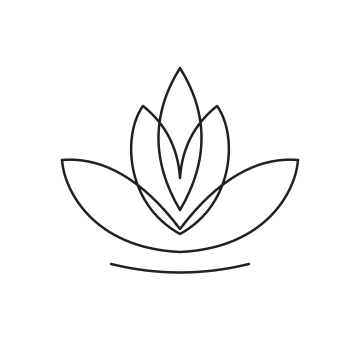
Open lotus
Original vector study · visual reference, not a finished stencil
Try on →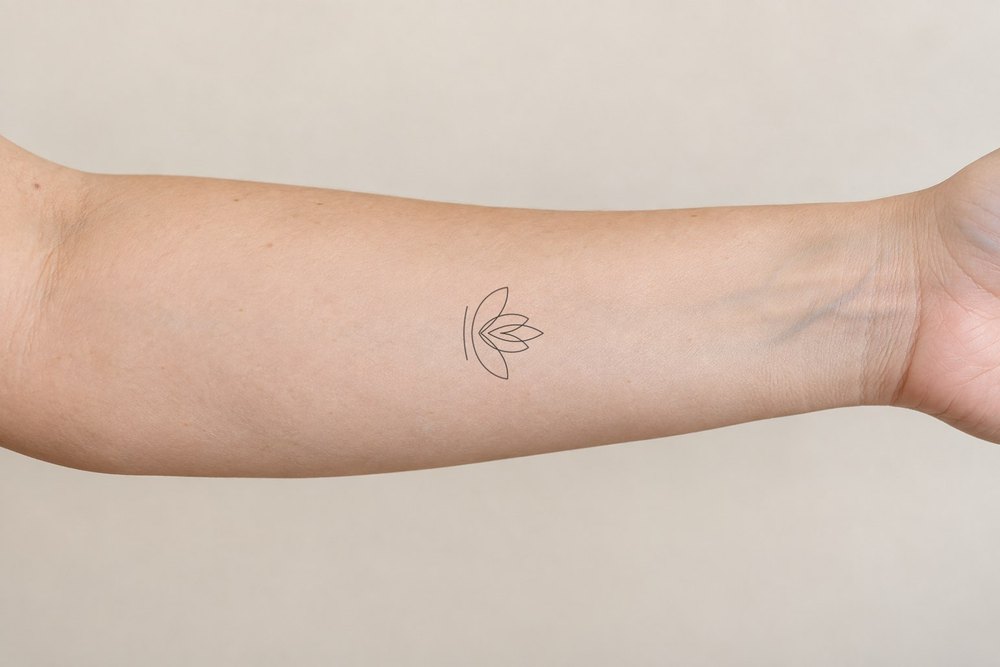
Forearm
Classic composite · adult AI model · not a real tattoo
Try this placement →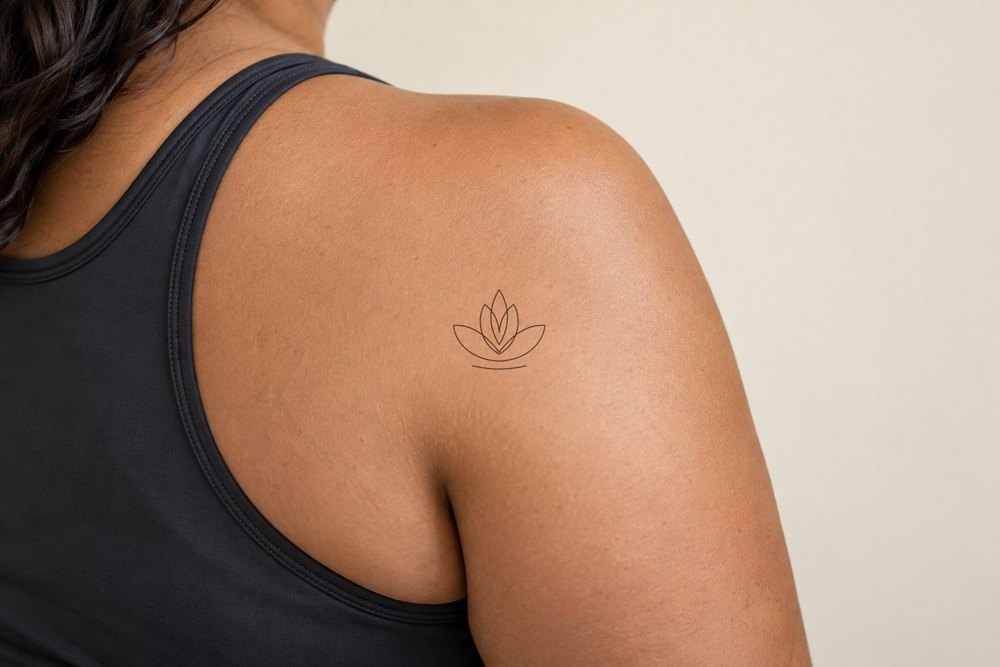
Shoulder
Classic composite · adult AI model · not a real tattoo
Try this placement →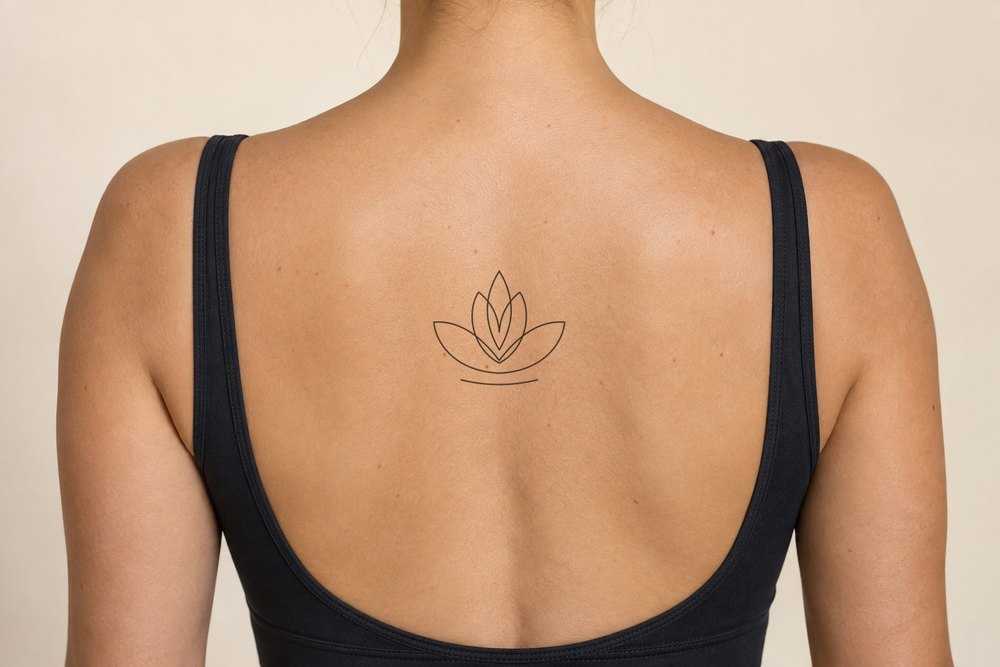
Back
Classic composite · adult AI model · not a real tattoo
Try this placement →Try it on your skin
Preview a design on your photo without leaving this page. Choose an adult body preset or upload a photo, then adjust position, size, and angle. Classic is free and requires no sign-in; photo processing stays in your browser. Download a reference before replacing your current draft.
This is a flat visual comparison, not a prediction of healed ink, skin movement, or physical dimensions. Bring the original drawing and preview to your tattoo artist.
Try on your photo →Prefer a full workspace? Open the tattoo simulator.
Lotus Flower Tattoo FAQ
What does a lotus flower tattoo mean on a woman or a man?
Gender does not determine its meaning. Growth, a new beginning, or a researched spiritual connection can matter to anyone. The flower’s shape and your personal reason are more informative than a gender label. Do not assume that someone practices a religion because they wear a lotus.
Where should I put a lotus tattoo?
Compare the width of the petals on your wrist, forearm, shoulder, or back. A symmetrical flower needs visible space around both sides. Choose the view you want to see most often, then ask an artist to confirm the actual dimensions and position rather than measuring from the screen.
What can a lotus tattoo mean in a mental health context?
You may choose it as a private reminder of growth or continuing through a difficult period. That meaning belongs to you; the image does not reveal a diagnosis or prove recovery. It is a personal symbol, not a treatment or a requirement to discuss your experiences.
Can I choose a small lotus tattoo?
Yes, you can explore a simplified lotus with fewer petal divisions. The preview helps compare its outline at different sizes, but does not decide which details will work in ink. Show your preferred size and open spaces to an artist who can adapt the drawing.