SYMBOLS & STORIES · TatTryOn editorial
Dragon Tattoo Meaning
Help me make this meaning personal →
Dragon tattoo meaning: identify the creature first
The word dragon covers many different images. A long winding body, a winged fantasy creature, and an emblem copied from a historical object are not interchangeable design choices. Start by describing what you actually want to see. If your intention is personal strength or guardianship, say that directly rather than claiming every dragon in every tradition carries the same message.
A protective pose can be calm rather than aggressive. An open mouth and prominent claws produce a different mood from a creature curled around an empty space. Decide whether the image should feel watchful, energetic, or playful before adding details. Our sample is an original stylized fantasy dragon; it is not offered as an authentic version of a particular regional tattoo tradition.
Eastern and Western dragons: avoid one universal story
For a specific Chinese example, The Met’s Vase with Dragon amid Clouds describes associations with protection, happiness, fertility, and water. A person may draw on such imagery to express strength, wisdom, or auspicious hopes, but those intended readings should be identified rather than assigned to every Chinese dragon. The object’s context gives a firmer starting point than a generic “Eastern dragon” label.
Japan Search’s Dragons gallery discusses Japanese dragon deities and their connections with water and rain. Chinese and Japanese examples can share visual relationships without being identical traditions. Do not use a simple claw-count formula as a universal way to identify an image. The source, period, artist, and surrounding symbols matter more than an unsupported rule about a single anatomical feature.
A contrasting European example is the dragon opposed by Saint George in Christian art; The Met’s collection explanation describes the creature as part of that dangerous encounter. Modern fantasy can instead make a dragon a guardian or companion. “Western” does not automatically mean evil, just as “Eastern” does not automatically mean benevolent. State whether you want a specific historical reference or an original fantasy design.
Context sources: The Met: Chinese dragon among clouds · Japan Search: Dragons · The Met: Saint George and the Dragon. These describe particular sources and contexts, not universal tattoo meanings.
Black, green, blue, and red dragon ideas
Black can emphasize the outline; green can connect your personal fantasy design with vegetation or a landscape; blue can support a water theme; red can create a warm, forceful accent. These are suggested ways to direct a composition, not authenticated color meanings shared by all dragon traditions. A blue dragon is not automatically wiser than a red one, and black does not establish a demonic identity.
If a color belongs to a specific historical or religious reference, keep that source with the design and ask what the complete image represents. Otherwise choose the palette you enjoy and describe your intention plainly. The linked Winged dragon study is monochrome and original; it does not reproduce a Chinese or Japanese dragon and cannot validate a traditional color scheme.
Should the dragon face upward or downward?
An ascending curve can be your personal way of expressing ambition; a descending creature can follow a shoulder or arm composition. Neither direction has one mandatory spiritual meaning. Start with the face as the focal point and follow the body to the tail. Check that the horns and wings remain distinct when the reference is viewed at ordinary size.
Use the preview to rotate the whole drawing, but do not distort its anatomy to imitate a wrap that a single photograph cannot show. If the dragon is part of a larger scene, its direction may be determined by the other subjects. Ask your artist to explain the composition rather than accepting an unsupported warning that one orientation is always unlucky.
Placement: protect the head and overall curve
The head often provides the clearest recognizable feature, so leave room around it. A long body can guide the eye down a forearm, while a wider composition may use the back or shoulder differently. Look for awkward tangencies where a horn, wing tip, or tail meets the edge of the visible area. A small change in angle can make the outline easier to follow.
If your goal is a sleeve or a creature wrapping around the torso, a single flat preview is not enough to plan the whole piece. Classic shows only the visible surface of one photograph. Use it to explore an initial focal point, then discuss the complete composition with an artist using multiple views. Do not stretch the sample until it appears to cover a surface it cannot actually model.
Compare placement references: wrist tattoo examples · forearm tattoo examples · hand tattoo examples · ankle tattoo examples. See the tattoo placement guide for more ways to compare.
Linework, blackwork, and detailed dragon scenes
A simple outline lets you decide whether you like the shape before committing to scales, clouds, flames, or a background. Blackwork can make the silhouette more prominent; detailed shading requires a different drawing and more decisions about light and texture. The choice of style does not determine how brave, powerful, or spiritual the wearer is. It determines how the drawing communicates visually.
For a larger scene, choose one main relationship: a dragon following a curve, facing another object, or occupying an open area. Adding every familiar dragon motif can make the reference less coherent. Ask the artist to explain which details can survive the intended composition and which should be removed. A clean outline is a more useful starting point than a crowded digital image with no clear emphasis.
Browse style references: Fine line tattoo designs · Minimalist tattoo designs · Blackwork tattoo designs · Geometric tattoo designs · Watercolor tattoo designs. These galleries include other subjects and do not change a symbol’s meaning.
Design gallery: read the silhouette before the details
The previews below place the same original dragon study on three adult AI model photographs. They are Classic composites, not real tattoos or examples of an artist’s healed work. Compare the direction of the face, the space around the wings, and the way the tail ends. These visible differences are more useful for choosing an initial placement than assigning a new symbolic meaning to each body area.
Open the closest sample and make a second version with a different angle or size. Download the versions you want to discuss, and keep the original drawing separate. If a specific tradition matters to you, bring your historical source too: the generic sample cannot stand in for that research. The final design should resolve both the visual placement and the cultural context you choose to reference.
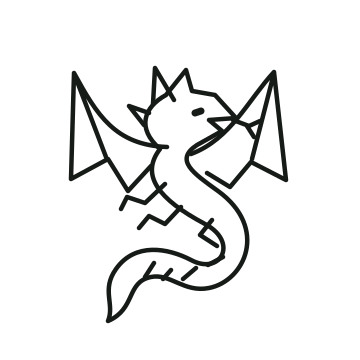
Winged dragon
Original vector study · visual reference, not a finished stencil
Try on →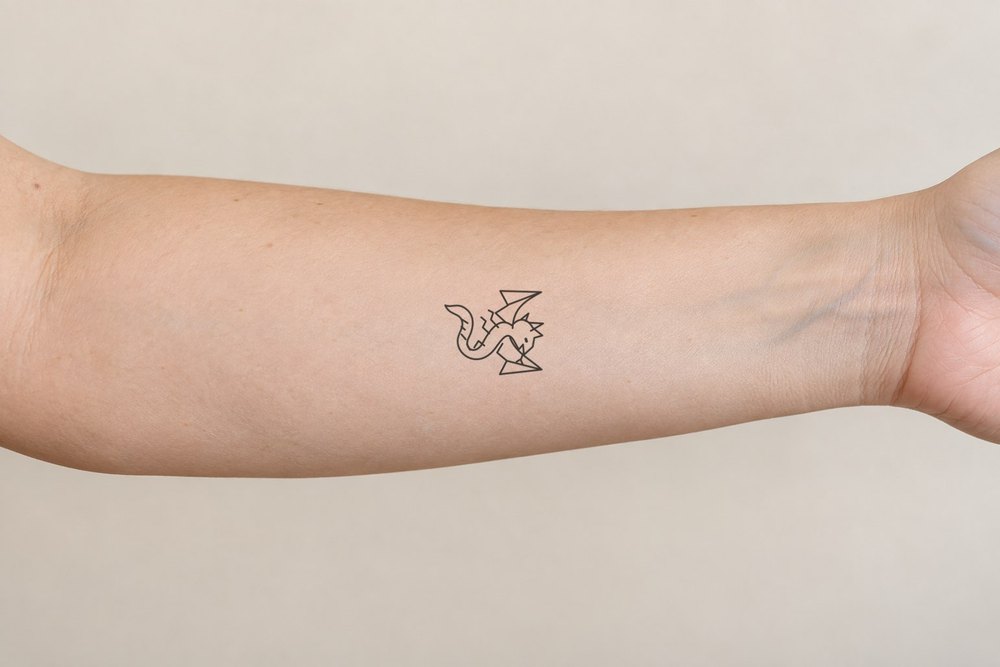
Forearm
Classic composite · adult AI model · not a real tattoo
Try this placement →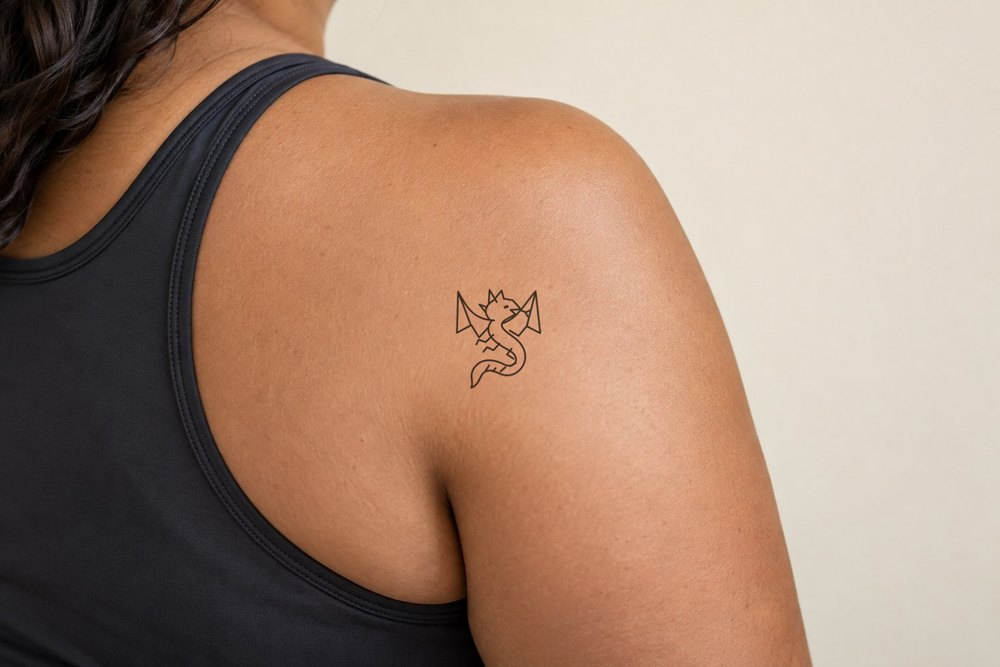
Shoulder
Classic composite · adult AI model · not a real tattoo
Try this placement →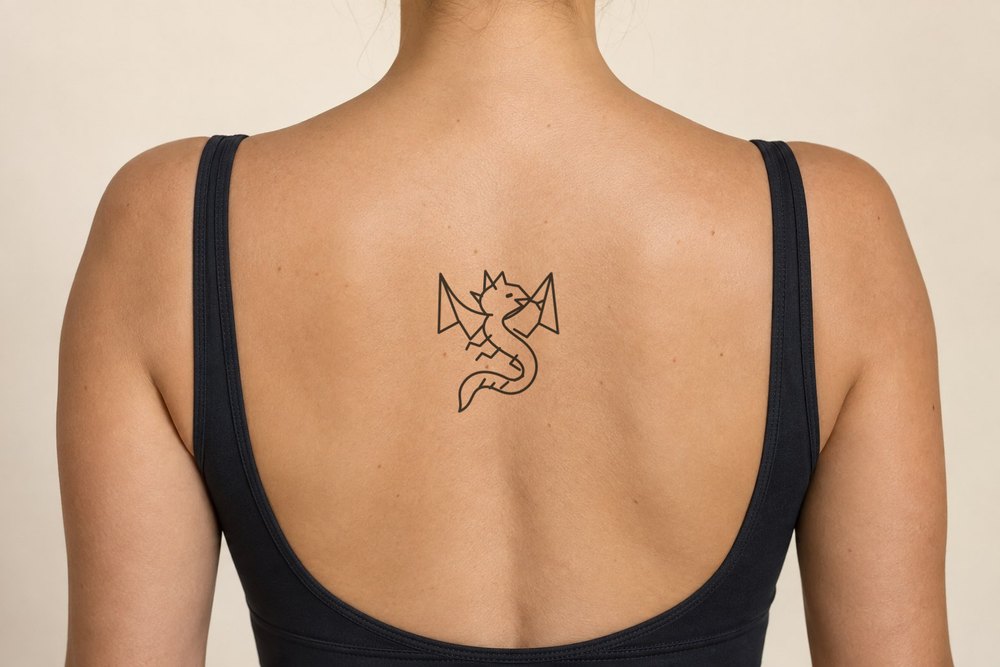
Back
Classic composite · adult AI model · not a real tattoo
Try this placement →Try it on your skin
Preview a design on your photo without leaving this page. Choose an adult body preset or upload a photo, then adjust position, size, and angle. Classic is free and requires no sign-in; photo processing stays in your browser. Download a reference before replacing your current draft.
This is a flat visual comparison, not a prediction of healed ink, skin movement, or physical dimensions. Bring the original drawing and preview to your tattoo artist.
Try on your photo →Prefer a full workspace? Open the tattoo simulator.
Dragon Tattoo FAQ
What is the meaning of a Japanese dragon tattoo?
It depends on the reference. Japan Search documents dragon deities associated with water and rain, but a modern tattoo can also carry a personal story. Identify the particular image and tradition; do not treat every Japanese dragon as an identical emblem with one fixed meaning.
Is a dragon a demonic symbol?
Not universally. A dragon can be an adversary in a specific Christian story, while other cultural and modern fantasy contexts give dragons different roles. Look at the complete reference and the wearer’s intention instead of inferring religious allegiance from the creature alone.
Does a dragon tattoo mean something different for guys or for a woman?
Gender does not assign a different definition. Guardianship, imagination, strength, or a specific cultural connection can matter to anyone. Choose the drawing and scale that work for your taste, rather than making a design more aggressive or delicate because of a stereotype.
Should a dragon tattoo go up or down?
There is no universal direction rule. Compare the two orientations against the visible body area and any neighboring tattoos. Upward movement can be your intended story, but downward placement is not automatically negative. An artist should resolve the complete composition and physical fit.