SYMBOLS & STORIES · TatTryOn editorial
Rose Tattoo Meaning
Help me make this meaning personal →
Rose tattoo meaning: love, memory, or a flower
A rose is a useful starting point when your idea concerns affection or a lasting memory, but it does not have to stand for a romantic relationship. You might connect it with a garden, a gift, or a particular time in your life. If the association is private, you can keep the explanation private too. A recognizable flower can carry a story without spelling that story out in lettering.
Write down the connection before deciding on the drawing. “The rose from our garden” suggests a different reference from “a bold flower I enjoy looking at.” Both are valid design briefs. If you have a photograph of a meaningful bloom, bring it to your artist as background rather than expecting the generic sample here to represent its exact species, shape, or history.
Floral symbolism has a context
The Met’s discussion of floral messages in historic valentines describes roses used for love and combined with other flowers to adjust meaning. That is evidence for a particular visual tradition, not a master dictionary for all tattoos. The combination, occasion, and audience matter. A flower can be familiar while still carrying different associations for different people and communities.
Treat online color charts cautiously if they do not identify a source or historical setting. Two charts may assign incompatible meanings to the same shade because they are discussing different traditions or simply repeating unsourced claims. For a personal tattoo, you can state your chosen meaning directly. For a historically inspired design, preserve the reference and check its explanation before borrowing its symbolism.
Context sources: The Met: A Rose by Any Other Name. These describe particular sources and contexts, not universal tattoo meanings.
Red, pink, purple, and black rose meanings
Red can be your way of expressing love and passion: the color may connect the flower to an anniversary, a gift, or simply a palette you enjoy. That personal association does not prove that every red rose tattoo is romantic. A wearer might be recalling a garden or a particular artwork instead. Describe your own connection before adding a name, date, or ribbon that changes the design’s focus.
Pink can support an intended feeling of gratitude, tenderness, or grace. If you want to thank someone through the image, decide whether the flower alone carries that memory or whether another private detail matters more. These are proposed personal readings; we are not presenting pink as a universal historical code. A softer color does not make the tattoo inherently feminine or restrict who may wear it.
Purple can be chosen to express fascination, charm, or an unusual kind of beauty. It can also simply work with colors in an existing tattoo. A palette that feels mysterious to one person may feel joyful to another. The useful question is what you want the purple to do in the composition, rather than whether a stranger will decode the exact same message.
A black rose can be a remembrance design, a statement about an ending, or a purely graphic choice. It does not establish grief, a negative personality, or a failed relationship. Distinguish a rose drawn with black outlines from one with heavily filled petals: they can look very different while carrying the same intention. Do not assume that the outline sample on this page is a demonstration of a solid black flower.
The Met’s article on historic floral messages shows why context matters: roses appear in different combinations and settings, including friendship and love. It does not supply a universal red-pink-purple-black tattoo chart. Keep color meanings as personal choices unless you have a documented reference. Our simulator compares a monochrome drawing’s placement; a colored version needs its own artwork.
Context sources: The Met: historic floral messages and roses. These describe particular sources and contexts, not universal tattoo meanings.
With thorns or without: what changes?
Thorns can express a personal contrast between affection and difficulty, or they can simply make the stem look more botanical. Leaving them out can make a small outline simpler. Neither choice proves that love is painful or that a relationship is easy. If thorns matter to your story, tell the artist how much visual emphasis you want them to have.
Compare the negative spaces around the stem as well as the bloom. Several small thorns can compete with leaves in a compact drawing, while one clearly placed thorn may be enough for your intended detail. Bring a plain and a thorned sketch if you are unsure. The artist can help keep the flower readable without assigning your relationship a predetermined narrative.
Placement: bloom and stem have different needs
The flower head creates a roughly rounded focal point; the stem adds direction and length. A forearm can support a longer stem, while a shoulder composition might place more emphasis on the bloom. On the back, compare whether you want a centered botanical study or an off-center accent. None of these placements changes the rose into a fixed statement about love, loss, or identity.
Check the leaf tips and the end of the stem, not just the middle of the bloom. Those edges can make a placement feel considered or cramped. Turn the design slightly and compare another version before deciding. The photo simulator does not measure actual dimensions or account for skin movement, so keep the digital reference as a conversation starter for the artist’s placement process.
Compare placement references: wrist tattoo examples · forearm tattoo examples · hand tattoo examples · ankle tattoo examples. See the tattoo placement guide for more ways to compare.
Fine line, bold petals, and realistic roses
Fine line leaves the spaces between petals visible and can make the drawing feel open. A bolder treatment can simplify the bloom into larger shapes with a clear outline. A realistic rose uses a different drawing approach with shading and specific petal folds. Choose the style based on the result you enjoy, not on a claim that one style is automatically more meaningful than another.
Thorns, a ribbon, or a second flower can add narrative, but they can also compete with the bloom. If a thorn represents a difficult part of your story, describe that as your interpretation rather than a universal rule. Compare the plain rose with one added element first. This makes it easier to decide which details are essential and which you are comfortable letting the artist simplify.
Browse style references: Fine line tattoo designs · Minimalist tattoo designs · Blackwork tattoo designs · Geometric tattoo designs · Watercolor tattoo designs. These galleries include other subjects and do not change a symbol’s meaning.
Design gallery: compare the same stemmed rose
Below, one original rose study is composited onto three adult AI model photographs using Classic placement. The drawing stays the same so you can compare how the bloom and stem sit within different visible body areas. These are not photographs of real tattoos. They cannot show a healed texture, the behavior of colored ink, or a continuous wrap around a limb.
Open the placement closest to your idea and try a second angle before downloading a reference. If the rose represents a specific person or occasion, keep those notes alongside the image for your artist. The visual preview solves a composition question; it does not decide what the memory should mean. A simpler drawing may communicate your intention more clearly than a crowded arrangement of several symbols.
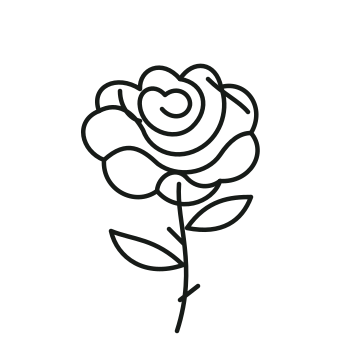
Stemmed rose
Original vector study · visual reference, not a finished stencil
Try on →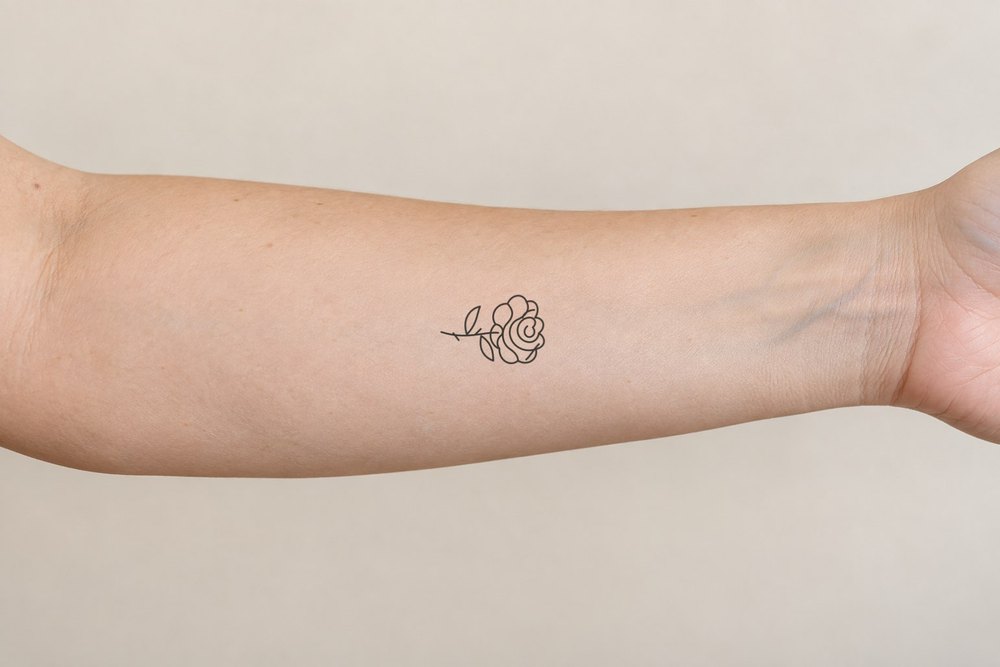
Forearm
Classic composite · adult AI model · not a real tattoo
Try this placement →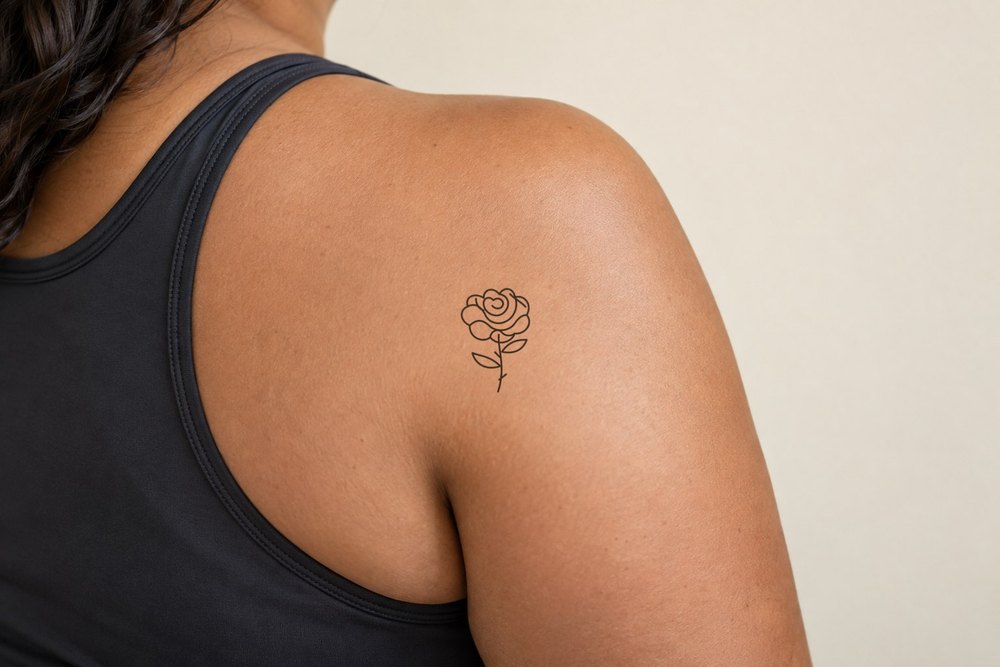
Shoulder
Classic composite · adult AI model · not a real tattoo
Try this placement →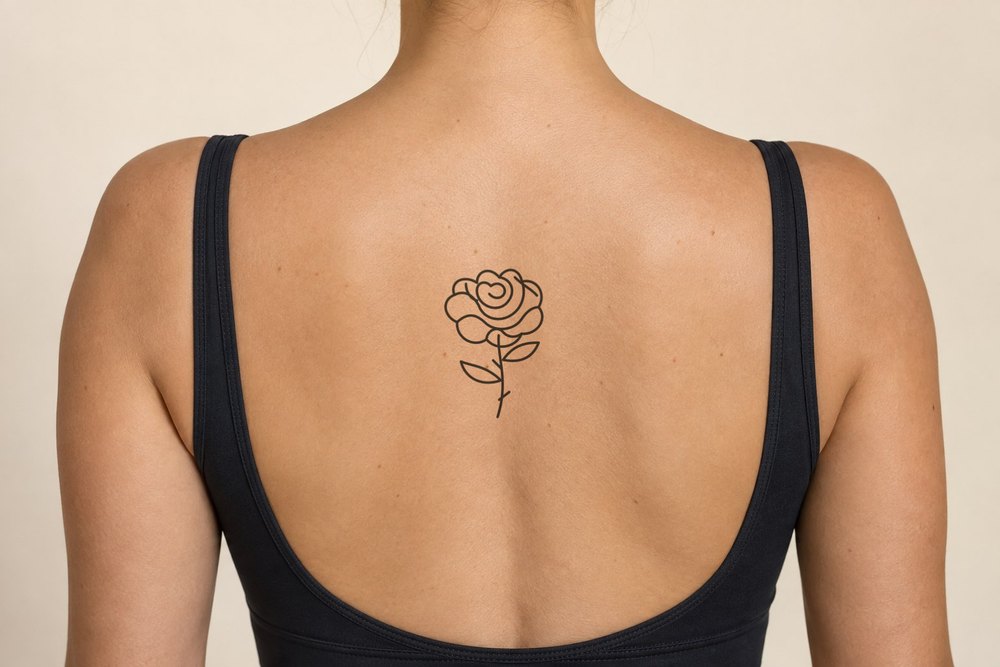
Back
Classic composite · adult AI model · not a real tattoo
Try this placement →Try it on your skin
Preview a design on your photo without leaving this page. Choose an adult body preset or upload a photo, then adjust position, size, and angle. Classic is free and requires no sign-in; photo processing stays in your browser. Download a reference before replacing your current draft.
This is a flat visual comparison, not a prediction of healed ink, skin movement, or physical dimensions. Bring the original drawing and preview to your tattoo artist.
Try on your photo →Prefer a full workspace? Open the tattoo simulator.
Rose Tattoo FAQ
What does a rose tattoo symbolize for a girl or woman?
It can express love, remembrance, friendship, a favorite garden, or an interest in the flower itself. Gender does not define the meaning. The wearer’s own reason matters more than a color chart or assumptions about what a woman is expected to choose.
What is the meaning of a red rose tattoo?
Love and passion are possible personal intentions, but not compulsory definitions. A red rose might also recall a place, gift, or artwork. If a specific historical reference matters, identify it separately; a broad association with romance does not explain every individual tattoo.
What does a rose tattoo mean on the wrist or hand?
The location affects visibility, not a universal symbolic code. A wrist rose may be easy for its wearer to see; a hand design may be more visible in everyday interactions. Compare your work routines and clothing before choosing the position, then confirm it with your artist.
Does a rose tattoo have a spiritual meaning?
It can when tied to a particular belief or artwork. The Met article includes roses in devotional imagery, but that does not turn every rose into a religious symbol. Research the complete reference and distinguish that tradition from your own personal interpretation.